

Custom Built-Ins vs. Modular Closet Systems: What Every Luxury Homeowner Should Know Before Deciding
Quick Summary
- True custom built-ins are permanently anchored to your home’s structure, use furniture-grade materials, and are designed to match your architecture — modular systems are not.
- Over a 10–15-year window, custom-built-ins typically hold their value and contribute to home appraisal; modular systems depreciate like furniture.
- The real cost difference isn’t just dollars — it’s the daily experience of a space that either adds calm or quietly creates chaos.
It works. Sort of. But it doesn’t feel right.
If you’re weighing true custom-built-ins against a high-end modular system, you’re asking exactly the right question. This guide will give you a straight answer — no sales pressure, no glossy vagueness. Just the honest breakdown of what separates these two approaches, and what that difference actually means for your home, your wardrobe, and your resale value.
The Anatomy of a True Custom Built-In
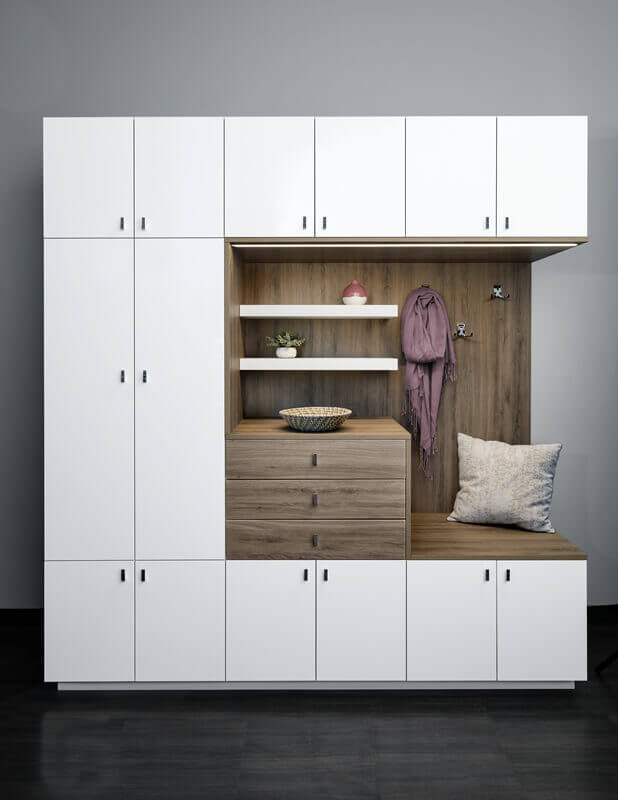
A custom built-in isn’t just a closet system. It’s millwork — the same category as your kitchen cabinetry, your built-in bookshelves, or the wainscoting in a well-appointed dining room.
Here’s what that means structurally:
- Anchored to the home’s framing. Custom built-ins are secured directly into wall studs and floor plates, not hung on a wall-mounted track.
- Built from furniture-grade or commercial-grade materials. Solid wood, plywood, or MDF with hardwood face frames — not the particle board and melamine common in retail modular kits.
- Designed to your exact dimensions. Every inch of ceiling height, every awkward corner, every sloped wall is accounted for. There are no gaps, no filler panels, no visible hardware tracks.
- Finished to match your home. Paint color, stain, hardware, and trim details are selected to feel original to the architecture — not like something you ordered online and installed yourself.
Think of it this way: a custom built-in is to a modular closet system what a custom kitchen is to an IKEA kitchen. Both hold your things. Only one looks like it belongs.
The Limitations of Modular Adjustability
Modular systems — whether from The Container Store’s Elfa line, IKEA’s PAX, or a franchise like California Closets — are engineered for flexibility and mass production. That’s their strength. It’s also their ceiling.
The core issue isn’t the brand. It’s the method.
Modular systems are built around a fixed set of components: standard widths, standard heights, and standard bracket intervals. When your closet doesn’t conform to those standards (and most don’t), the system compensates with filler pieces, visible gaps at the ceiling, or hardware that simply stops short of the wall.
That gap — the two-inch space between the top of your modular tower and the ceiling — is what designers call visual noise. It’s a small thing. But it registers every morning. It signals “storage solution” rather than “this was designed for this room.”
For a homeowner who has spent years curating a beautiful home, that gap is the equivalent of a picture frame hung slightly crooked. You see it every time.
Beyond aesthetics, there’s a durability question. Particle board — the substrate used in most modular systems — absorbs moisture, swells over time, and can sag under the sustained weight of a full wardrobe. Shelves loaded with shoes, folded denim, or stacked sweaters will test those materials within a few years. Furniture-grade plywood and solid wood do not have the same failure mode.
Aesthetic Alignment With Your Home: Why It Matters More Than You Think
Here’s something the modular brands don’t advertise: their systems are designed to look good in a showroom, not in your home.
A showroom is a neutral environment. Your home has a specific architectural language — crown molding profiles, door casing styles, hardware finishes, and paint palettes. A modular system arrives with its own aesthetic vocabulary, and it rarely speaks the same language as your home.
Custom built-ins are designed in the opposite direction. We start with your home’s existing details and work outward. The result is a closet that doesn’t look like it was added — it looks like it was always there.
This matters most in luxury homes, where architectural harmony is part of what you paid for. A primary suite in a Buckhead estate or a Midtown high-rise has a specific feel. A modular tower with visible cam-lock hardware and a laminate finish disrupts that feel. A floor-to-ceiling custom wardrobe in painted MDF with inset doors and integrated lighting enhances it.
The goal isn’t more storage. It’s a space that eliminates visual noise and creates a boutique-organized environment worthy of what’s inside it.
If you want to see what that looks like in practice, our custom walk-in closet portfolio shows examples of architectural harmony in primary suites across Atlanta.
Durability and Lifespan: The 15-Year Test
Let’s talk about the long game.
A well-built custom built-in, installed with commercial-grade materials and proper structural anchoring, is a permanent fixture of your home. It doesn’t depreciate. It doesn’t go out of style. And unlike a modular system, it doesn’t need to be disassembled and replaced when you renovate.
| Custom Built-Ins | Modular Systems | |
| Core Material | Furniture-grade plywood / solid wood | Particle board/melamine |
| Structural Anchoring | Secured to the wall framing | Wall-mounted track or freestanding |
| Lifespan | 20–30+ years | 5–10 years (typical) |
| Sag/Warp Risk | Very low | Moderate to high under sustained load |
| Finish Options | Unlimited (paint, stain, custom hardware) | Limited to the manufacturer’s catalog |
| Home Appraisal Impact | Classified as a permanent fixture | Classified as personal property |
| Warranty | Lifetime (The Closet Shop) | Varies; typically 1–5 years |
That last row is worth pausing on. When a licensed appraiser walks through your home, they distinguish between permanent fixtures and personal property. A custom-built-in is a fixture — it adds to the assessed value of the home. A modular system is personal property — it moves with you, or gets left behind as a depreciated asset.
Luxury real estate professionals in Atlanta’s top markets consistently note that buyers in the $1M+ range respond to custom millwork as a value signal. It communicates that the home was built and maintained with intention.
Are Custom Closets Worth the Investment Over Modular Systems?
For the right homeowner, yes — unequivocally.
The calculus is straightforward. If you’re in a home you intend to own for five or more years, in a neighborhood where finishes and craftsmanship drive resale value, a custom-built-in pays for itself in two ways: the daily quality-of-life return and the appraisal impact at sale.
The homeowner who gets the most value from a custom-built-in is someone who:
- Has a wardrobe worth protecting (luxury handbags, tailored suits, designer shoes)
- Values architectural harmony and is bothered by visual inconsistency
- Plans to stay in their home long enough to amortize the investment
- Wants a done-for-you experience with minimal disruption
If you’re renting, planning to move in 18 months, or primarily need a functional solution in a secondary space, a quality modular system may serve you well. We’ll always tell you the truth about that.
But if your closet is in your primary suite, in a home you’ve invested in, in a neighborhood where finishes matter — this is not the place to compromise.
How Much Does a Custom Built-In Closet Cost Compared to a Modular System?
This is the question most buyers have, but few vendors answer directly. Here’s an honest framework.
Modular systems (Elfa, IKEA PAX, franchise-level California Closets) typically range from $1,500 to $8,000 for a primary walk-in, depending on size and configuration. The lower end is largely DIY; the higher end involves professional installation of mass-produced components.
True custom-built-ins from a luxury cabinetry specialist typically start around $8,000–$12,000 for a primary walk-in and scale upward based on square footage, material selections, lighting, and specialty features (glass fronts, integrated islands, velvet-lined drawers).
The gap is real. But so is the difference in what you’re getting.
A modular system is a product. A custom built-in is a permanent improvement to your home — one that uses commercial-grade cabinetry materials, is backed by a lifetime guarantee, and is installed by craftspeople who treat your home as their own.
If you’d like a precise estimate for your space, we offer a design consultation — not a sales appointment. We’ll walk through your space, understand your lifestyle, and give you a clear picture of what’s possible and what it costs.
What to Expect on Installation Day
One of the most common concerns we hear: “I’ve had contractor experiences that turned into months of disruption. I can’t do that again.”
We hear you. Here’s the reality of a custom-built-in installation with The Closet Shop.
Your design is finalized in a 3D consultation before a single piece is cut. Every component is fabricated in our shop, not assembled on-site from a kit. On installation day, our team arrives on time, works efficiently, and is typically in and out in as little as one day. We leave your home cleaner than we found it.
There’s no drywall dust. No open walls. No weeks of waiting. Just a finished space that looks like it was always there.
Conclusion: The Right Question to Ask Yourself
The comparison between custom-built-ins and modular systems isn’t really about shelves. It’s about what kind of space you want to live in every day.
Modular systems solve a storage problem. Custom built-ins solve an experience problem — the visual noise, the mismatched finishes, the sense that this one room doesn’t quite belong in the home you’ve worked hard to build.
Your home is a masterpiece. Your closet should be, too.
Schedule a design consultation with The Closet Shop — serving Las Vegas and Atlanta homeowners. We’ll handle every detail — from the first 3D rendering to the final installation — so you can simply enjoy the result.
Frequently Asked Questions
Can modular closets look like custom-built-ins?
With careful planning, modular systems can approximate a built-in look — but they rarely achieve it fully. The telltale signs are the gaps at the ceiling and walls, visible track hardware, and the absence of architectural trim details. True custom-built-ins are designed to your exact dimensions and finished to match your home’s existing millwork, which is something no off-the-shelf modular system can replicate.
Do custom closets increase home resale value more than modular systems?
Yes, in most cases. Licensed appraisers classify custom-built-ins as permanent fixtures, which means they contribute to the assessed value of the home. Modular systems are classified as personal property and do not. In luxury markets — particularly in Atlanta neighborhoods like Buckhead, Sandy Springs, and Alpharetta — custom millwork is a recognized value signal that buyers and appraisers respond to positively.
How long does it take to install a custom-built-in closet vs. a modular system?
A modular system can be assembled in a day or two, but the design process is largely self-directed. A custom-built-in involves a design consultation, fabrication, and installation — but the on-site installation itself is typically completed in as little as one day. The Closet Shop handles every step, so the process is far less disruptive than most homeowners expect.
